

In 1976, in the final chapter of a book mostly about genes, Richard Dawkins needed a word. He had spent the previous two hundred-odd pages arguing that the real unit of evolution was not the lion or the lily or the human being, but the gene: a replicator that copies itself down the generations and treats the body it lives in as a temporary vehicle. In the last chapter he asked the obvious follow-up question. If culture also evolves, what is its replicator? What is the cultural equivalent of the gene? He coined a word for it, clipped from the Greek mimeme and filed down to rhyme with "gene". He called it the meme.
Fifty years on, the word has done precisely what the theory predicted. It copied itself from brain to brain. It mutated. And it drifted so far from its origin that most people who use it daily have no idea it was born in a book about evolutionary biology, let alone that its father is an Oxford don who is, by his own cheerful admission, faintly horrified by what it became. Asked at the Hay Festival in 2024 whether the internet version dismayed him, Dawkins gave the only answer a memeticist could give: it is itself a fine example of a meme spreading. "It's the wrong one," he told the audience, "but never mind."
The word "meme" is, in other words, a meme that escaped its maker. It proves its own theory simply by existing. I have found that very funny for nearly thirty years now, because I once spent an entire dissertation taking the idea completely seriously.

In 1997, as a design student, I wrote my final dissertation on the two cathedrals of Liverpool. The Anglican and the Catholic sit at either end of Hope Street, “glaring at one another” across the city, and I argued that they were not really buildings at all. They were advertisements. More than that, they were replicators: artefacts that a religion builds in order to copy itself into the next generation, in much the same way a beaver builds a dam or a bird builds a nest. I borrowed the framework wholesale from Dawkins and his idea (and book) of the extended phenotype, the notion that a gene's reach stretches past the body and into the things the body makes. The selfish gene says a chicken (A phenotype or body) is a way to make an egg (a gene), but if a chicken could make tools then those tools would also help the egg survive. You can still read the whole strange thing on this blog: Cathedrals, Memes, Advertising, God and Liverpool.
It was, as the blog version now happily admits, a wide-ranging and not-a-little-mad piece of work. But the central instinct never left me. My first company was called Phenotype. I named it because of that dissertation, because I love the idea that what we make is an extension of who we are. And design is an extended phenotype (and it has the word type in it).
So there is some history here in this anniversary. I was using the academic meme in earnest, with footnotes, at almost exactly the moment the internet was quietly preparing to take the word away from people like me forever.
Why it stuck, and how the internet took it
The word stuck for a simple reason. It filled a hole in the language. Before "meme" we had no clean way to name a unit of culture that spreads on its own terms. We had "tradition", "fashion", "idea", all of them either too vague or too grand. Dawkins handed us a word with a whole mechanism folded inside it. To call something a meme was to say that it copies, it competes, and it lives or dies on its ability to be passed on, not on whether it happens to be true, or good, or useful to the person passing it along.
That last point is the one that matters, and it is the one my dissertation kept circling back to. The memes that survive, Dawkins argued, are simply the ones that make the most copies. They are not necessarily good for us. He went on to famously write about the idea of God. He could just as easily have been writing about a forwarded reaction GIF.
Because that is exactly where the word went. In 1993 the writer Mike Godwin coined the phrase "internet meme" to describe the way jokes and images were replicating through Usenet groups, email chains and message boards. The mechanism was identical to the one Dawkins had described. Only the medium had changed. The internet turned out to be, as Dawkins himself put it when he appeared at the Cannes advertising festival in 2013, "a first class ecology for memes". Copying became frictionless. Mutation became a Photoshop layer. Selection became a like button. The slow, generational drift of culture he had described suddenly ran at the speed of a page refresh.
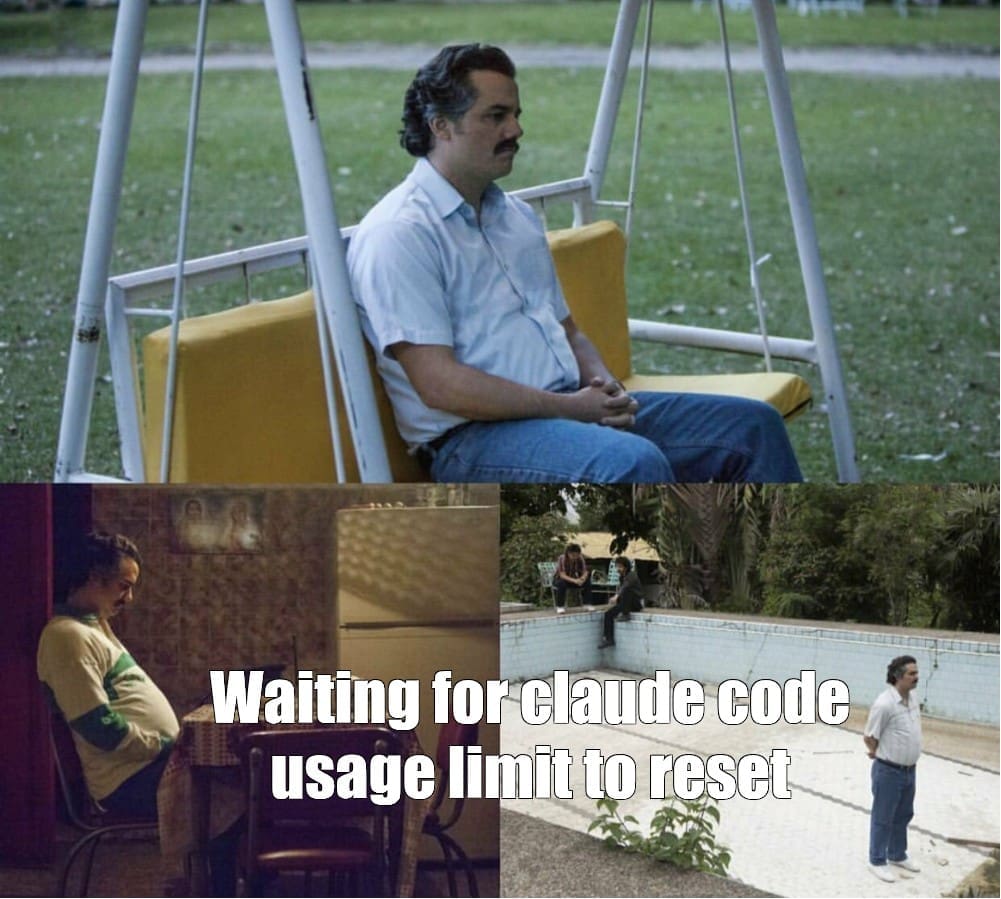
And the word came along for the ride. By the 2010s "meme" no longer meant a unit of cultural inheritance. It meant a picture of a cat with words on it. The academic meme had been comprehensively out-competed by its own offspring, which is the most Dawkinsian outcome imaginable.
A short, daft history
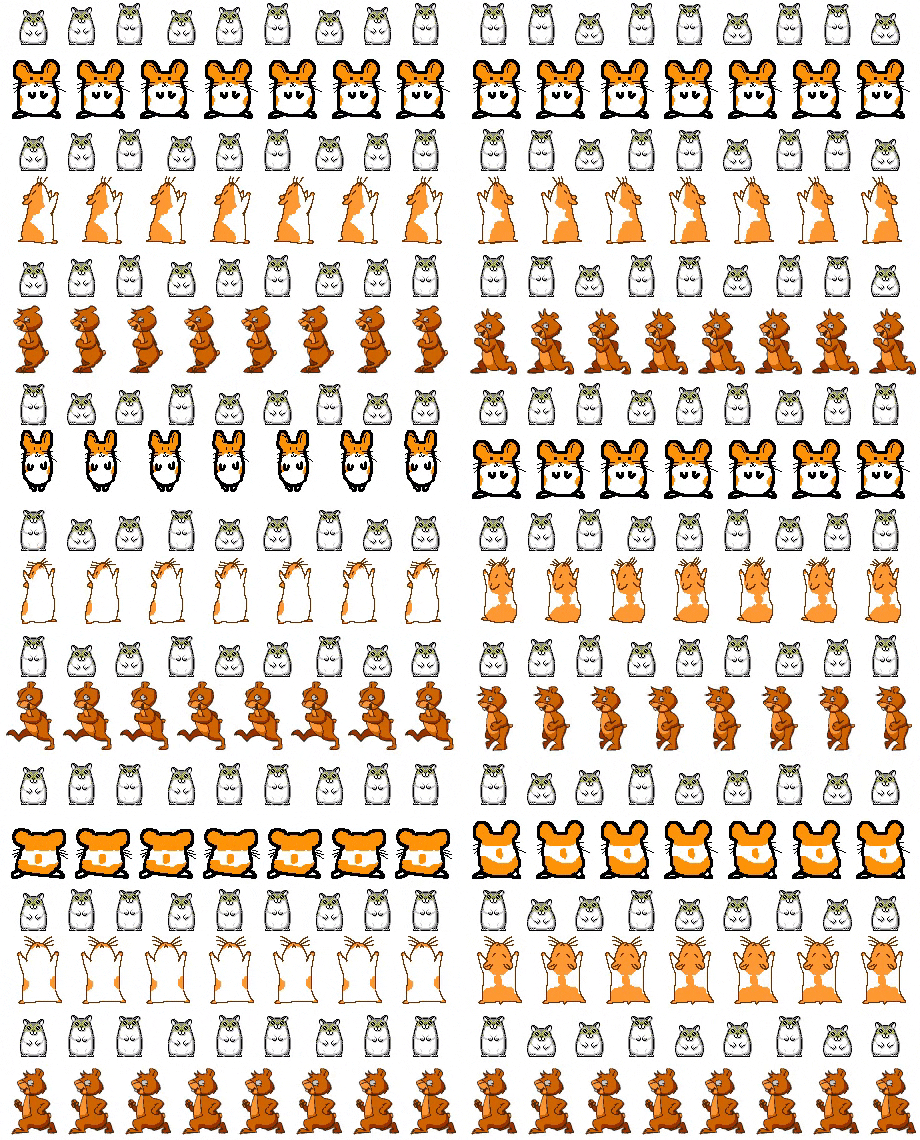
For something so disposable, the internet meme has a surprisingly traceable lineage. The smiley emoticon, Scott Fahlman's :-) typed onto a Carnegie Mellon message board in 1982, is arguably ground zero: a tiny replicating unit of tone. Then came the slow-loading curiosities of the early web. The Dancing Baby that boogied across the late nineties. The Hampster Dance. "All Your Base Are Belong To Us", a mangled translation lifted from a Japanese video game that became the internet's first real in-joke at scale. These are what passed as high entertainment in the late nineties.
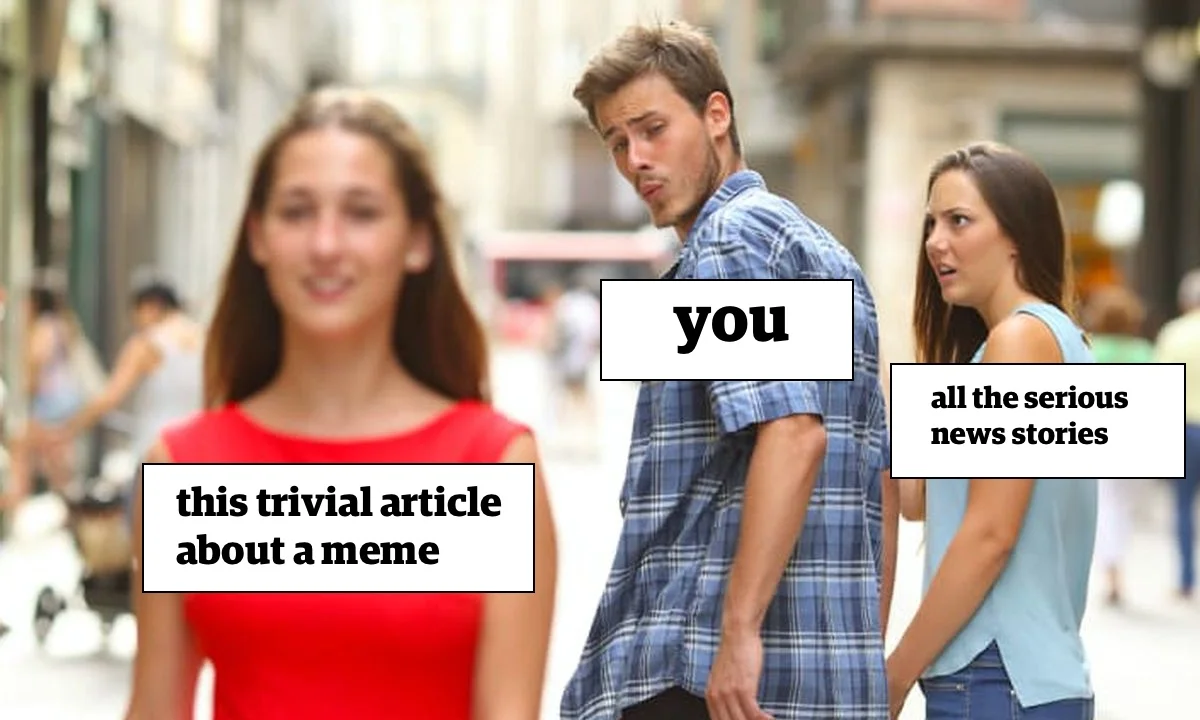
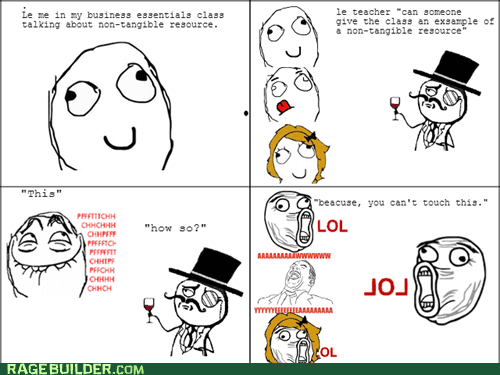
The mid-2000s gave us the golden age of the image macro: LOLcats and "I Can Has Cheezburger", the Advice Animals, the Rickroll, Rage Comics with their crudely drawn faces. These were communal, low-fi and gloriously stupid, and crucially they were made by hand, by people, one at a time. The 2010s industrialised the lot. Distracted Boyfriend, Drakeposting, the format wars of Twitter, then Instagram, then TikTok. The meme became a visual language fluent enough to carry political campaigns, mental health support and genuine grief, often in the same afternoon.
Which brings us, half a century after Dawkins first reached for the word, to a culture so saturated with memes that it has started trying to reset itself. And just like genes it is so very easy to drift into the language of it being a thinking planning organism.
The great reset, or rather, the two resets
At the start of 2026 the internet staged a small revolt against itself. The Great Meme Reset, a campaign that began on TikTok and then spread everywhere, declared the first of January 2026 a clean slate. The complaint was that memes had rotted: too fast, too ironic, too hollow, and increasingly churned out by AI rather than made by people. The proposed cure was nostalgia. Rewind the feed to roughly 2016, bring back the "dank" memes of the last golden age, flush out the slop. Some users went further still, buying digital cameras and scrapbooks, rewinding not just the memes but the whole texture of being online.
It is a charming idea. It is also, I think, a stunt, because it misreads its own diagnosis. The Great Meme Reset tries to change what survives without changing the environment that does the selecting. It is still broadcasting into the same open, exhausting, algorithm-sorted feed. It simply wants nicer, more “real”, things to broadcast. Dawkins would gently point out that you cannot fix the output of a selection process by being sentimental about it. The feed will go on selecting for whatever spreads fastest, and just now that is slop. There is that intelligent design trope again.
There is a second reset happening at the same time, far quieter, and I think far more important. It is the steady migration of actual sharing out of the public feed and into private rooms: the family WhatsApp group, the six-person chat, the close-friends story. We are de-massifying. The meme you send your sister at eleven at night is not competing for the attention of millions. It is competing in a pool of six people who already know exactly why it is funny, will read it and will get all the context. On the big wide internet we are becoming bland, generic slop.
And here, at last, my old dissertation earns its keep. A meme's survival has never depended on the meme alone. It depends on its environment, the pool in which it is selected. Change the pool and you change what wins. The open feed selects for the broadest, loudest, most frictionless content, which is precisely why it silts up with slop. The group chat selects for the specific, the personal, the in-joke that would die on its feet in public. These are two different ecologies, and they breed two different “species”.
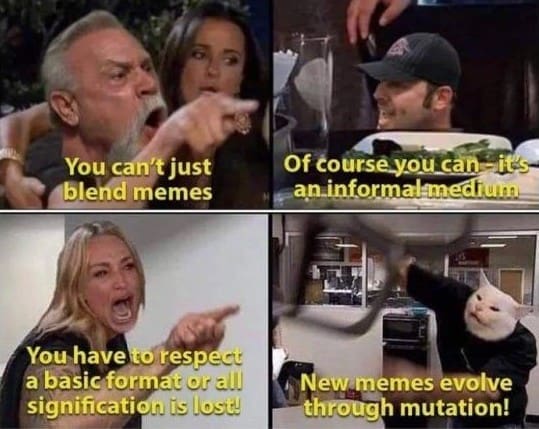
Fifty years ago Dawkins described culture as a contest between replicators in an environment. We are about to watch that environment split in two, and the memes that survive the coming decade will be shaped, as they always have been, less by what they are than by where they are allowed to breed. Memes are here to stay – it is in the dictionary - but what form they take and how they are delivered will be very different in 10, let alone 50 years.
Dawkins would, I suspect, call that a fine example of a meme spreading. The wrong one. But never mind.
Further Reading & References
A curated set of links to illustrate "Fifty Years of the Meme", grouped to match the article's sections. (R) marks a solid reference; (F) marks a fun read.
The origin: Dawkins and the academic meme
- (R) The Selfish Gene (1976) — overview of the book where the word was coined, in its final chapter: https://en.wikipedia.org/wiki/The_Selfish_Gene
- (F) "Talking to the Guy Who Invented the Word 'Meme'" — VICE interview in which Dawkins gives his own plain definition and shrugs at internet culture: https://www.vice.com/en/article/talking-to-the-guy-who-invented-the-word-meme-richard-dawkins/
- (R) Richard Dawkins interview, The Freethinker (2022) — useful for his genuine scepticism about whether internet memes are truly selected in any meaningful evolutionary sense: https://freethinker.co.uk/2022/07/an-animal-is-a-description-of-ancient-worlds-interview-with-richard-dawkins/
- (F) "Richard Dawkins reflects on inventing the word 'meme'" — the Hay Festival 2024 exchange and the "it's the wrong one, but never mind" line: https://www.aol.com/richard-dawkins-reflects-inventing-word-110059671.html
- (R) Memetics — the academic rabbit hole, for readers who want the theory rather than the cat pictures: https://en.wikipedia.org/wiki/Memetics
From biology to broadband: how the word jumped
- (R) Internet meme — covers Mike Godwin's 1993 coinage of "internet meme" and Scott Fahlman's 1982 :-): https://en.wikipedia.org/wiki/Internet_meme
- (F) Richard Dawkins on Know Your Meme — including his 2013 Cannes Lions appearance, where he called the internet "a first class ecology for memes": https://knowyourmeme.com/memes/people/richard-dawkins
A short, daft history
- (R) "What was the first meme?" — CNN's surprisingly thoughtful attempt to trace patient zero: https://www.cnn.com/us/first-meme-ever-cec/index.html
- (F) "A brief history of the Dancing Baby meme" — TechCrunch on the 1996 original viral sensation: https://techcrunch.com/2014/06/15/a-brief-history-of-the-dancing-baby-meme
- (F) "Classic Memes of the Internet's Early Years" — the CNN/WHNT roundup from your own notes: https://whnt.com/news/digital-life/classic-memes-of-the-internets-early-years/
- (F) "From LOLcats to Prehistoric Penises: The History of Memes" — a nicely written UK student-paper take that also nods to Kilroy and pre-internet imitation: https://www.thebubble.org.uk/culture/history/from-lolcats-to-prehistoric-penises-the-history-of-memes/
- (F) Know Your Meme — the canonical database itself; link it once and lose your readers for an hour: https://knowyourmeme.com/
The Great Meme Reset (2026)
- (R) "The Great Meme Reset of 2026" — Know Your Meme's authoritative breakdown of the campaign, its origins and its targets: https://knowyourmeme.com/memes/the-great-meme-reset-of-2026
- (F) "What Is the Great Meme Reset of 2026?" — Slate's ICYMI podcast with meme historian Aidan Walker; a good listen if you want a human voice on it: https://slate.com/podcasts/icymi/2026/01/what-is-the-great-meme-reset-of-2026
- (R) "The Great Meme Reset Is Coming" — WIRED, from your own notes: https://www.wired.com/story/the-great-meme-reset-is-coming/
- (F) "What Is 'The Great Meme Reset of 2026'?" — SheKnows on the teens actually driving it, including the digital-cameras-and-scrapbooks angle: https://www.sheknows.com/parenting/articles/1234941813/great-meme-reset-2026-teens/
- (F) "'The Great Meme Reset' Turns 2026 into 2016" — Bruin Banner feature with a good rundown of the 2025 "brainrot" memes it was reacting against: https://bruinbanner.com/4137/features/the-great-meme-reset-turns-2026-into-2016/
The quiet reset: into the group chat
- (R) "Social media users opt for new privacy haven" — University of Michigan research on the shift from public feeds to private, chronological group spaces, and why people feel more in control there: https://news.umich.edu/?p=195318
- (R) Dark social, explained — Buffer's primer, which traces the term back to Alexis Madrigal's 2012 piece in The Atlantic and the discovery that most sharing is invisible to analytics: https://buffer.com/resources/dark-social/
https://www.tiktok.com/@mindflation/video/7594849996260838687
https://www.facebook.com/groups/greenbaysocialmedia/posts/24148037301545456/